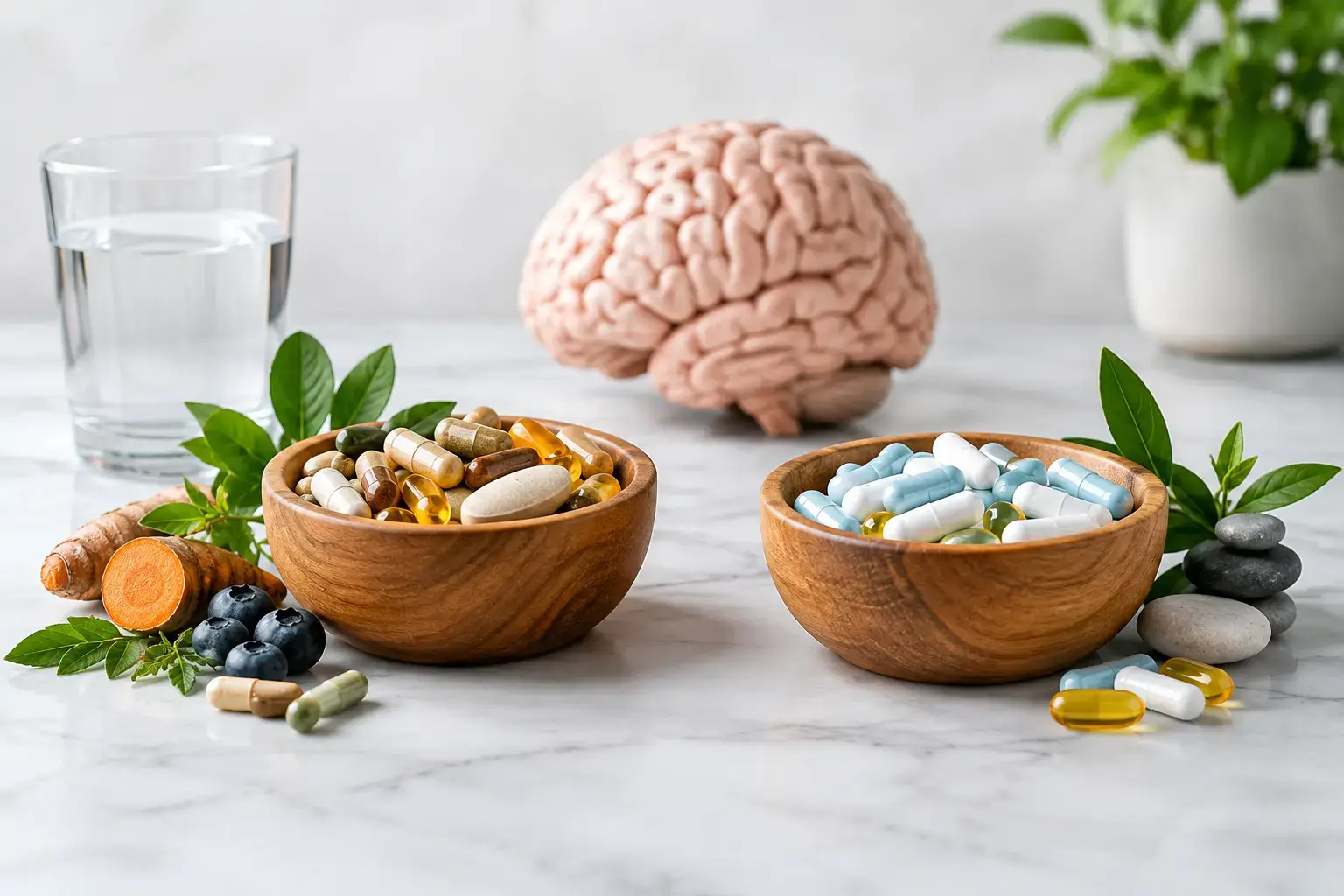
Nutraceuticals Versus Nootropics: What Matters?
A sharper memory is not the same thing as a healthier brain. That distinction gets lost when the conversation turns to nutraceuticals versus nootropics. One category is often marketed around feeling more focused this afternoon. The other can be designed to support the deeper conditions that help the brain remain resilient over years: nutrition, inflammation balance, circulation, sleep, cellular maintenance, and the brain’s own waste-clearance processes.
For anyone worried about cognitive decline, Parkinson’s disease, Alzheimer’s disease, dementia risk, or the frightening changes they see in a parent or spouse, this is not a word game. It is a question of strategy. Are you simply trying to push harder on a tired brain, or are you supporting the system responsible for maintaining it?
Nutraceuticals Versus Nootropics: The Core Difference
A nootropic is broadly defined as a substance intended to support cognitive performance. People use the term for caffeine, L-theanine, creatine, certain mushrooms, prescription stimulants, and a long list of compounds promoted for attention, motivation, memory, or mental speed. The promise is usually immediate and compelling: clearer thinking, better concentration, more drive.
A nutraceutical is a nutrition-derived product used to support health beyond basic calorie intake. That can include vitamins, minerals, amino acids, botanical extracts, fatty acids, and specialized combinations formulated around a particular health goal. Some nutraceuticals may also have nootropic effects, but their purpose can be much broader than a short-term cognitive lift.
The overlap matters. A supplement can be both a nutraceutical and a nootropic. But the intent behind the formula changes the question you should ask. A nootropic-centered product often asks, “How can we enhance performance?” A brain-health nutraceutical should also ask, “What is placing strain on this brain in the first place, and what biological systems need support?”
That is not a small difference. A stronger signal is not always the same thing as a stronger system.
The Brain Is More Than Neurotransmitters
Many nootropic conversations stay focused on neurotransmitters: dopamine for motivation, acetylcholine for memory, serotonin for mood, or GABA for calm. These chemical messengers matter. They help neurons communicate, regulate movement, shape attention, and influence how we feel.
But neurotransmitters are only one part of a much larger picture. The brain also depends on energy production, blood flow, immune signaling, sleep architecture, structural fats, antioxidant defenses, and the removal of metabolic waste. When any of these systems struggle, the effects may show up as brain fog, slower recall, fatigue, poor sleep, mood changes, or reduced mental stamina.
The danger is assuming every cognitive problem is a neurotransmitter problem. That is like hearing a car engine sputter and deciding the only possible cause is the spark plugs. Perhaps it is. Or perhaps the fuel line is blocked, the oil is low, or the cooling system has failed.
For aging brains, maintenance is not optional. It is the mission.
Why Glymphatic Support Changes the Conversation
One of the most consequential developments in brain-health research is the growing understanding of the glymphatic system. Often described as the brain’s dishwasher, this network helps move fluid through brain tissue and assists in clearing metabolic waste products. Its activity is closely connected to quality sleep, especially deep sleep.
Think of the brain as a kitchen sink used all day. Neurons are constantly working, communicating, producing energy, and generating byproducts. If the drain is functioning, the system can keep up with normal use. If the drain is compromised, waste can accumulate. Eventually, the problem is no longer what you put into the sink. It is what is not getting out.
Research has connected disrupted sleep and impaired clearance pathways with the accumulation of proteins associated with neurodegenerative disease, including amyloid-beta and tau. That does not mean a supplement can diagnose, treat, prevent, or cure Alzheimer’s or Parkinson’s. It does mean that a brain-support strategy focused only on stimulation may be missing one of the most important maintenance conversations available.
This is where systems-level nutraceutical thinking becomes compelling. Instead of treating the brain as a switchboard to stimulate, it views the brain as a living environment that must be nourished, protected, rested, and cleared.
When a Nootropic May Make Sense
Nootropics are not the enemy. A well-chosen nootropic may be useful for a specific, limited goal. Caffeine paired with L-theanine, for example, may help some adults feel alert without as much jitteriness as caffeine alone. Creatine may support cognitive performance under sleep deprivation or high mental demand in certain people. Other ingredients have emerging, mixed, or population-specific evidence.
The trade-off is that feeling sharper can mask the need for recovery. A stimulant can help you work through a poor night of sleep, but it cannot replace deep sleep. A focus supplement may help you finish a demanding project, but it cannot correct unmanaged sleep apnea, medication side effects, depression, thyroid dysfunction, nutrient deficiency, or vascular risk.
Nootropics also deserve more caution in older adults and in anyone managing a neurological condition. Stimulants and stimulating botanicals can worsen anxiety, elevate heart rate, disrupt sleep, or interact with prescriptions. People with Parkinson’s disease, dementia, cardiovascular conditions, seizure disorders, or complex medication regimens should involve a qualified clinician before adding cognitive supplements.
The right question is not, “Will this make me feel something?” It is, “Is this appropriate for my biology, my medications, and my actual goal?”
What a Brain-Health Nutraceutical Should Do Differently
A serious brain-health nutraceutical should be built around support, not hype. That means looking beyond a trendy ingredient and asking whether the formula reflects how the brain really functions under stress and with age.
First, the ingredients should have a plausible role in brain physiology, whether through nutritional sufficiency, cellular protection, circulation, sleep support, stress response, or healthy inflammatory balance. Second, the formula should respect dosage, quality, purity, and potential interactions. A long label is not evidence. A proprietary blend that hides amounts is not transparency.
Third, the formula should fit a larger plan. No capsule can outmuscle chronic sleep loss, uncontrolled diabetes, heavy alcohol use, untreated hearing loss, persistent isolation, or a sedentary life. Those are not moral failures. They are real pressures on the brain, and they deserve practical attention.
This is why My Brain Restore™ frames brain support around the glymphatic system and the brain’s natural maintenance pathways rather than a simple neurotransmitter rush. For people who want to preserve independence and protect what matters most, that mechanism is worth understanding.
How to Choose Without Falling for the Label
The supplement aisle is built to provoke urgency. “Memory.” “Focus.” “Brain booster.” “Clinically proven.” These claims can make a bottle look more certain than the underlying evidence actually is.
Start by identifying your real need. Is the issue afternoon fatigue, poor sleep, forgetfulness, stress, mental overload, or fear because of family history? Those are not interchangeable concerns. A product designed for acute alertness may be poorly matched for someone whose primary issue is fragmented sleep and long-term neurological resilience.
Then examine the formulation with healthy skepticism. Look for clearly disclosed ingredients and amounts. Be cautious with promises that sound like drug claims, especially claims to reverse dementia, remove plaques, or replace medical care. Strong language is not strong science.
Finally, protect the foundations that no supplement can replace. Prioritize consistent sleep, movement, blood-pressure management, protein and nutrient-rich food, meaningful social connection, and medical evaluation when changes are new, progressing, or interfering with daily life. Sudden confusion, weakness, trouble speaking, severe headache, or abrupt changes in behavior require urgent medical attention, not a new supplement.
The Better Standard for Brain Support
The choice between nutraceuticals and nootropics is not always either-or. A person may use a modest nootropic for occasional performance needs while choosing a broader nutraceutical approach for long-term brain support. The problem begins when stimulation is sold as restoration.
Your brain has carried every memory, relationship, decision, and hard-won lesson of your life. It deserves more than a temporary jolt. Choose support that respects the whole system, ask better questions before you buy, and make room for the nightly maintenance work your brain was designed to do.
Similar Posts
How to Support Healthy Cerebrospinal Fluid Flow
Learn how to support healthy cerebrospinal fluid flow with sleep, movement, hydration, and medical awareness for long-term brain resilience every day.
Third Party Supplement Testing Review for Brain Health
A third party supplement testing review explains how to verify identity, purity, potency, and contaminants before choosing brain health formulas wisely.
Support for Cognitive Decline Caregivers That Helps
Support for cognitive decline caregivers: practical ways to protect your energy, coordinate care, ask better questions, and create room for hope every day.
Natural Brain Support for Family History Risks
Natural brain support for family history concerns starts with sleep, movement, and brain-clearance habits you can practice long before symptoms appear.
Supplements for Neurological Resilience
Learn how supplements for neurological resilience may support brain clearance, inflammation balance, and aging cognition with a smarter strategy.
Sleep Quality and Brain Restoration Explained
Sleep quality and brain restoration are closely connected. Learn how deep sleep supports the brain’s nightly cleanup, resilience, and clear daily thinking.